ServicesWhole-Home Filtration
Whole-Home Filtration in Temple Terrace
One system on your main supply line treats the water before it branches off to the shower, the washer and the kitchen faucet. If a tank is already sitting in your garage, our first step is finding out whether it can be put back to work.
How whole-home treatment works, and who it suits
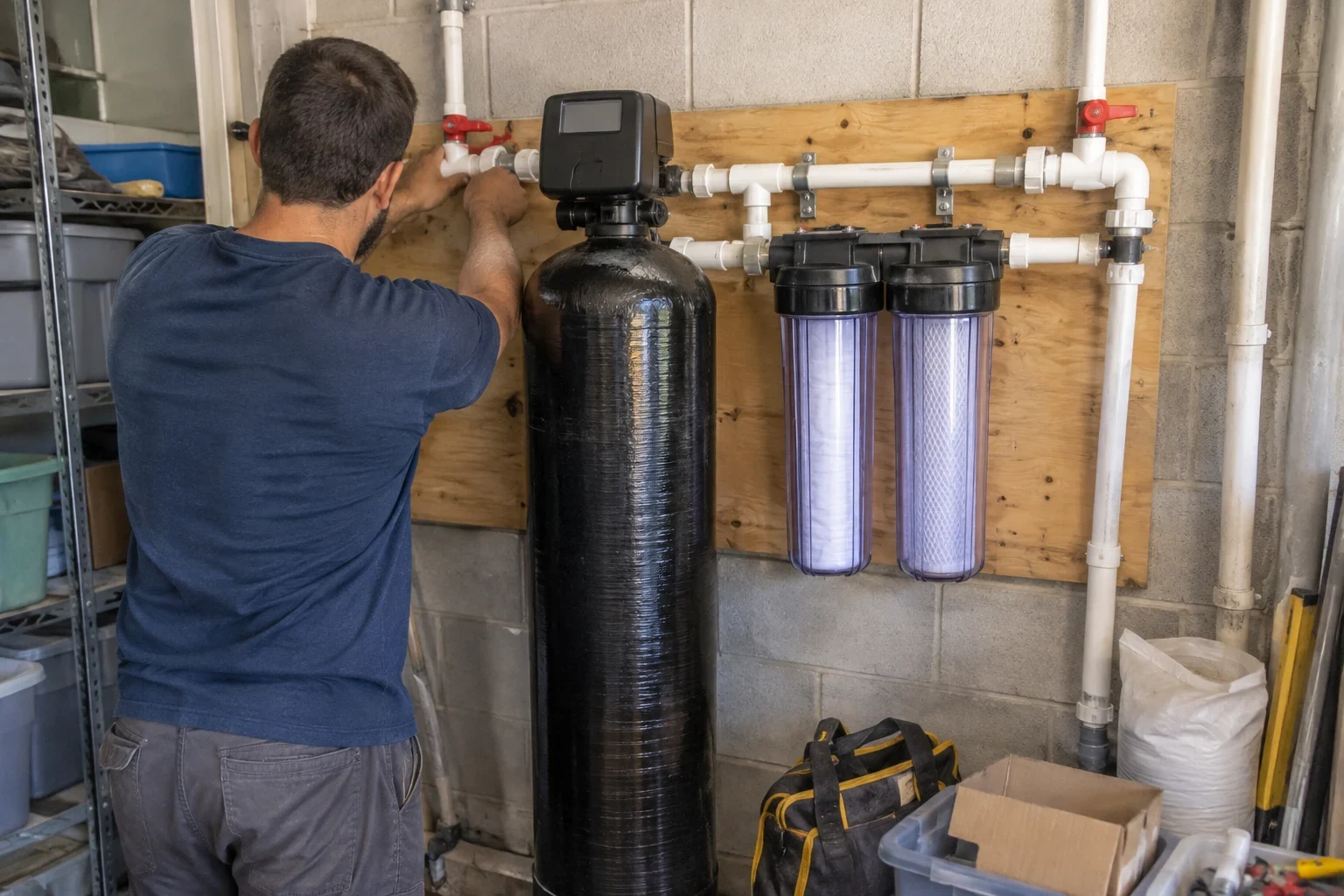
The system is mounted on the main line, typically close to where the supply comes through the garage wall or the side of the house. Incoming water first meets a sediment cartridge, then flows through a carbon tank, and only after that does it travel on to your fixtures. Every faucet and showerhead gets water with less taste and odor, not only the one beside the fridge.
It makes sense when the chlorine smell is just as noticeable in the bathroom as at the sink, or when you want filtered water for showers and laundry too. When the glass on the counter is the only thing that bothers you, a compact reverse osmosis system under the kitchen sink can be the simpler choice, and we will say so on the call.
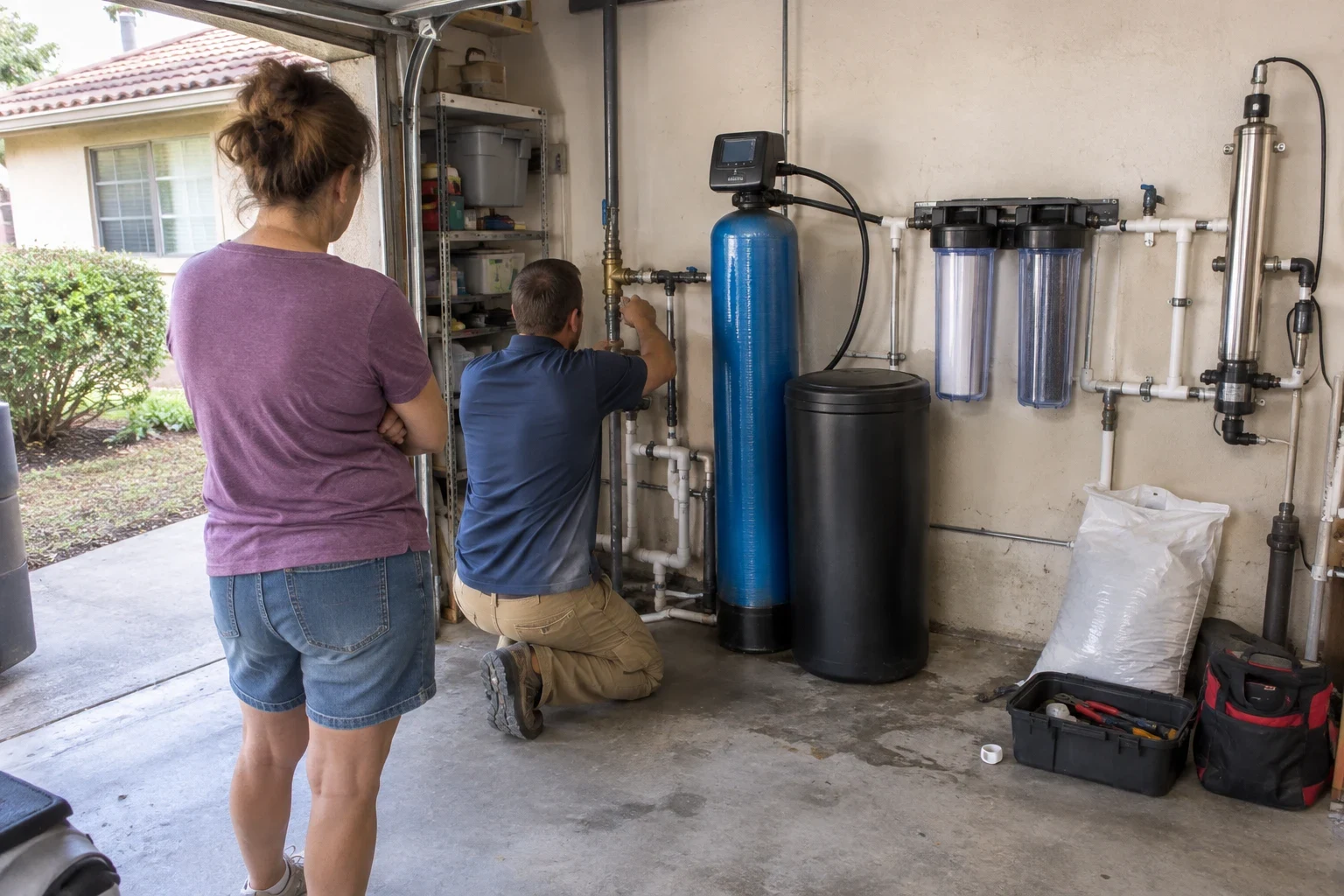
Plenty of Temple Terrace garages already hold a tank that stopped doing its job some time ago. The usual culprit is exhausted media or a tired valve rather than a dead system. We look at that before anything else, and we say clearly when a replacement is the better path.
What the installation includes
- Sediment prefilter
- A cartridge ahead of the main tank catches sand, rust flakes and grit. It protects the carbon media and keeps fine debris out of faucet aerators and appliance screens.
- Carbon or catalytic carbon tank
- Standard carbon handles chlorine well. Where chloramine is the concern, we use catalytic carbon, which is made to break it down. We size the tank to the flow your household actually uses.
- Bypass valve
- A bypass lets you send water around the system during service or a filter change. Your home keeps running water while the work is done.
- Clean connections at the main line
- We cut in with fittings matched to your existing pipe and support the tank so nothing strains the plumbing. Outdoor installs get a cover to keep sun and rain off the equipment.
- Flush, check and walkthrough
- New media is flushed until the water runs clear, every joint is checked for leaks, and we show you the valve, the prefilter and when each part needs attention.
When treating every tap makes sense
Chlorine you can smell in the bathroom
Warm water and steam release chlorine into the room, so the smell often hangs heaviest around the shower. A filter at the kitchen sink never reaches that water.
Debris in aerators and inlet screens
Sand or dark specks gathering in faucet aerators, the washing machine inlet or the ice maker line mean sediment is traveling through your plumbing.
Filters on every fixture
Keeping up with pitcher, fridge and shower cartridges gets tedious. A single system at the main line is usually simpler to look after.
A tank that has quietly given up
The equipment is still installed, yet the taste is back or the pressure has fallen off. New media, a cleaned valve or a fresh prefilter often fixes that without replacing the whole system.
From first call to finished install
- 1
Start with a phone call
Describe what you are noticing in your water and any equipment already installed. We will ask how many people live in the house and where the main supply comes in.
- 2
An on-site look
We check the plumbing, the space around the main line and any existing tank. When a repair can bring an older system back, that option comes first.
- 3
Your written estimate
Each part of the job is listed on its own line, and where repair and replacement are both possible, each is priced separately. The figure you approve is the figure you pay.
- 4
The install itself
Your water is shut off briefly while we tie in the system. We lay down floor protection along our route, flush the new media until it runs clear, test each connection for leaks and tidy up before we go.
What moves the cost of a system
We set the price only after seeing how your home is plumbed, because no two installs line up exactly. A handful of things account for most of the difference. Each one appears as its own line on your written estimate.
- Media choice and tank capacity
- Catalytic carbon, which we use when chloramine is the issue, is priced above standard carbon. A bigger household also needs a bigger tank so the water spends enough time in contact with the media without losing flow.
- Location of the main line
- An open wall in the garage keeps the work simple. A cramped corner, or an outside wall that calls for new mounting, a protective cover or added pipe, takes more time and material.
- Parts that are worth keeping
- When an existing tank, bypass valve or prefilter housing is still sound, we leave it in place. Reusing good parts brings the total down.
- Other equipment on the line
- Plumbing in a softener or an extra filtration stage alongside the carbon tank changes both the layout and the list of parts.
Whole-home filtration questions
Something not covered here? (813) 859-5527
Will a whole-home filter lower my water pressure?
When the tank is sized properly, you should not feel a difference at the faucet. Weak pressure is usually traced to a tank that is too small for the household or a prefilter packed with sediment. We size the system to your actual use, and if flow drops later, swapping the prefilter cartridge generally brings it back.
Does it remove chloramine as well as chlorine?
Ordinary carbon takes out chlorine readily but is slow against chloramine. Catalytic carbon is built for chloramine, so we specify it when that is what you are dealing with. You can read more on our Chlorine & Chloramine Removal page.
I already have an old system. Do I need a new one?
Often you do not. A lot of older units come back to life with new media, a replacement prefilter or a cleaned control valve. We inspect what you have first, then tell you whether the repair is worth it or whether a new system is the wiser spend.
How much upkeep does it need?
Plan on changing the prefilter cartridge on a regular schedule, and on replacing the carbon media every several years depending on how much water your home uses. We provide ongoing customer support for maintenance, filter replacements, and service needs, so the schedule is never a guessing game.
Do I still need reverse osmosis at the kitchen sink?
For many households, no. Once the water is treated where it enters your home, the chlorine taste and smell are gone from the bathrooms and laundry as well as the kitchen. Some people still choose an under-sink reverse osmosis unit for an extra stage on the water they drink and cook with, and the two systems work comfortably side by side.
Find out what your current setup needs
Let us know what you taste or smell in your water and what equipment is in the garage now. You will hear plainly whether a repair or a new system makes sense, with a written estimate behind it.