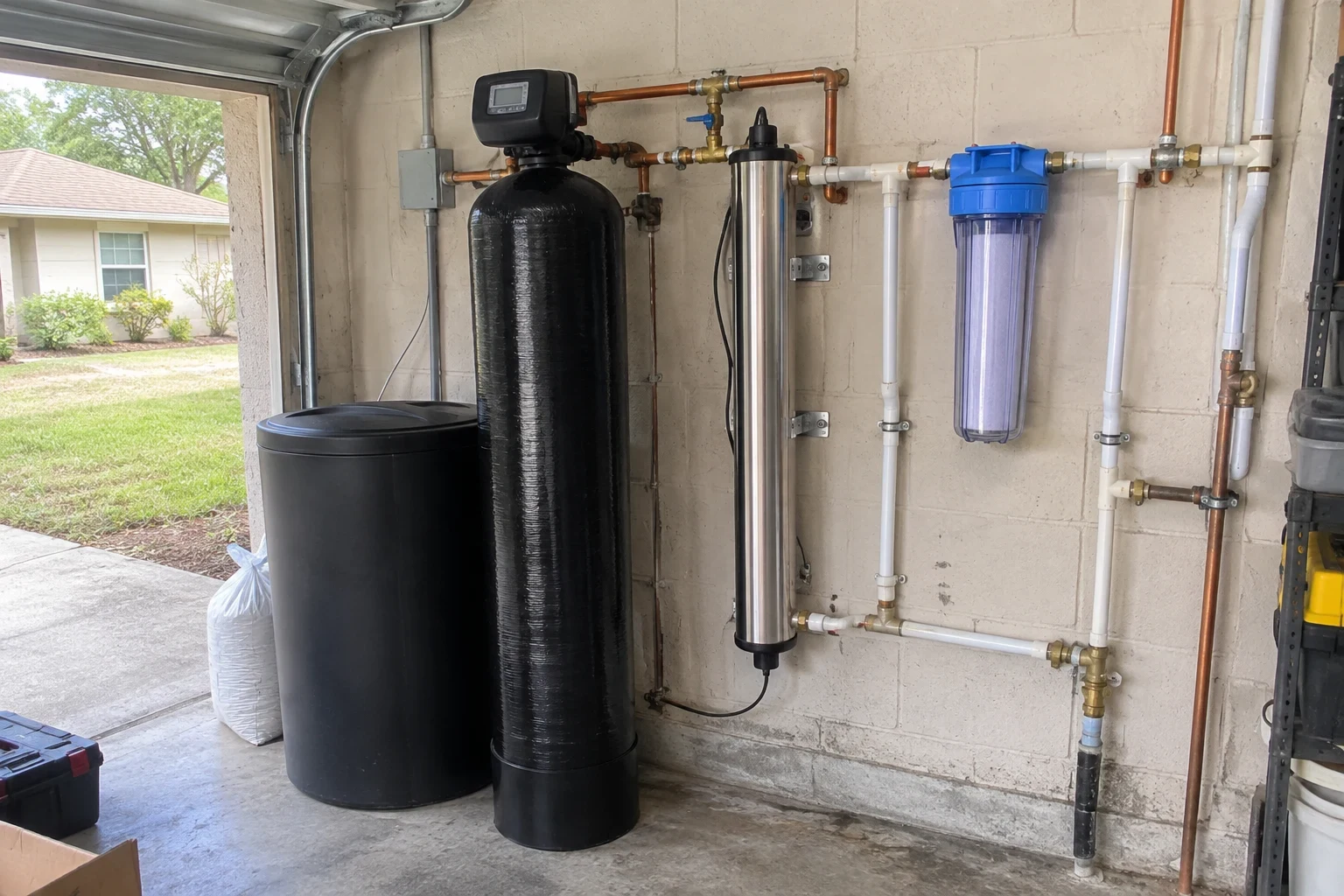
Can a Water Filter Remove Bacteria in a Temple Terrace Home?
The honest answer depends on the type of filter, the size of its pores, and how well it is maintained.
Can a water filter remove bacteria?
Some can, but most household filters cannot. Standard sediment and carbon filters are built for particles, chlorine and taste, not microbes. Reverse osmosis membranes and filters rated at 0.2 micron absolute physically block most bacteria, and ultraviolet treatment inactivates them. For a private well, UV paired with good prefiltration is the dependable answer.
Why most whole-home filters let bacteria through
A typical whole-home system has a sediment stage and a tank of activated carbon. Sediment cartridges are usually rated at 5 to 50 microns. Most bacteria measure between about 0.5 and 5 microns, so they pass straight through.
Carbon works by adsorption. It grabs chlorine, chloramine and many organic compounds that affect taste and odor, but it is not a disinfectant. It was never meant to be one, and a good installer will tell you so up front.
If your home is on treated city water, that is usually fine. The utility disinfects the water before it reaches your meter, and a carbon system is there to improve how the water tastes and smells at every tap.
Which filters can stop or kill bacteria
A few technologies do handle microbes. They work in different ways, and each has limits worth knowing before you choose one.
- Reverse osmosis: the membrane's pores are far smaller than bacteria, so it rejects them at the drinking water tap. It is not sold as a disinfection device, and the storage tank and faucet still need periodic sanitizing.
- Ultrafiltration and 0.2 micron absolute cartridges: these physically screen out bacteria. Look for an absolute rating, not a nominal one, since nominal ratings allow some larger particles through.
- Ultraviolet treatment: water passes a UV lamp inside a quartz sleeve, and the light damages the bacteria's DNA so they cannot reproduce. Nothing is added to the water, and nothing is removed either.
- Chlorination: a metered feed of chlorine disinfects well water, followed by carbon to take the taste back out.
Does removing chlorine make city water less safe?
This is a fair question, and it deserves a straight answer. Chlorine and chloramine are added partly to keep water clean as it travels through pipes. Once a whole-home carbon system removes them, the water past the filter carries less of that protection.
In practice, water in a home that is used every day moves through quickly, and this is rarely a problem. Where it can matter is in a house that sits empty for weeks, such as a seasonal home during the summer. In those cases we may suggest running every tap when you return, or adding a UV stage after the carbon tank. Our chlorine and chloramine removal work always starts with how you actually use your home, not with the biggest system on the shelf.
When a filter becomes the problem
A filter that is overdue for service can grow bacteria of its own. Carbon traps organic material, and Florida's warm water temperatures give microbes a comfortable place to settle. A cartridge left in place too long, or a reverse osmosis tank that has never been sanitized, can make water smell musty or taste flat.
That does not usually mean the system has failed. In many cases the right fix is a fresh cartridge, a sanitized housing, or a new UV lamp and a cleaned quartz sleeve. We recommend repair when the tank, valve and housings are sound, and we explain plainly when a cracked housing or a worn control valve makes replacement the better choice. We also offer ongoing customer support for maintenance, filter replacements, and service needs, so the schedule does not fall on you alone.
- Musty or earthy smell that appears suddenly
- Slime or discoloration inside a clear filter housing
- A UV lamp past its rated service life, even if it still glows
- Reverse osmosis water that tastes stale after sitting in the tank
What to do if your home runs on a private well
Well owners carry the responsibility a utility would otherwise handle. Florida's heavy summer rain can push surface water toward a shallow or poorly sealed well, which is when bacteria are most likely to show up.
For most wells, a sound setup is sediment filtration first, then any iron or sulfur treatment the water needs, then UV as the final step before water reaches your fixtures. The order matters. Cloudy or iron-heavy water shields bacteria from UV light, so the earlier stages protect the lamp's ability to do its job. Our well water treatment work is built around that sequence, sized to your household's flow rate rather than a guess.
More questions about filters and bacteria
Something not covered here? (813) 859-5527
Does boiling water do the same thing as a UV system?
Boiling kills bacteria in the pot you boil, which makes it a sound short-term measure. A UV system treats every gallon entering the house, including water for showers and dishes.
Will a refrigerator or pitcher filter remove bacteria?
Usually not. Most are carbon filters designed for taste and chlorine, and they can grow bacteria themselves if the cartridge is not replaced on schedule.
How often does a UV lamp need replacing?
Most lamps are rated for about a year of continuous use. The bulb can still light up after its output has dropped below an effective level, so replacing it on time matters more than whether it glows.
Can a reverse osmosis system be my only protection on a well?
It protects the one tap it serves, not the rest of the house. For a well with any history of bacteria, whole-home UV is the better foundation, with reverse osmosis added for drinking water if you want it.
Talk through your water with someone who will be straight with you
Tell us what feeds your home, city water or a private well, what system you have now, and what you are noticing. We will explain whether a repair, a service visit or a new stage makes sense, and what each would involve.